Central Virginia neighbors share concerns over proposed $1 billion transmission line project
 VENN
VENN
FLUVANNA COUNTY, Va. (WRIC) — A proposed $1 billion transmission line project that would run through parts of Central Virginia has sparked concern among residents who believe the project would negatively reshape their communities.
Valley Link's Joshua Falls to Yeat Electric Transmission Line Project would span across nine counties in Central Virginia, reaching from Culpeper County to Campbell County. The 115-mile, high-voltage transmission line is a joint venture by Dominion Energy, FirstEnergy Transmission and Transource Energy.
Developers say the project is needed to support Virginia’s growing demand for electricity -- but some homeowners along the potential routes say they're worried about how the project could affect their neighborhoods.
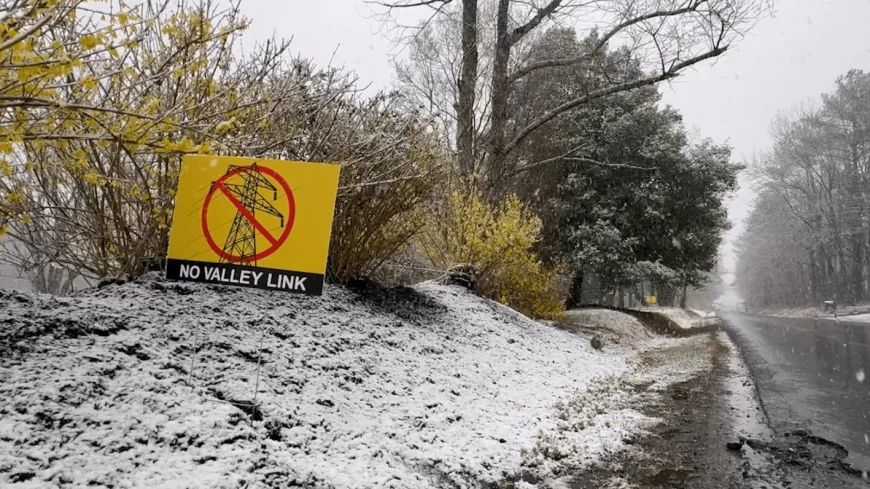
In a farming community outside Fluvanna County, yellow signs that read "No Valley Link" stand out against the snowy landscape along Mallory Road. David Conrath and Deena Stone have lived in the neighborhood for the past six years.
“[We] came down Mallory Road -- [we] saw the farm, saw the barns, saw the green, saw the space -- and that’s what we needed,” Stone said.
Conrath and Stone said the same qualities that drew them to the neighborhood are now being threatened by the proposed transmission line project.
“We left Northern Virginia and all the data centers up there, and we moved down here to where it’s peaceful and tranquil,” Conrath said. “And now it’s going to be buzzing transmission lines that are just passing through.”
According to Valley Link developers, the proposed 765-kilovolt transmission line would serve as a backbone of Virginia’s electric grid, delivering power to data centers, homes and manufacturers.
One of two potential routes could run near Conrath and Stone’s home, raising concerns about possible health risks, damage to nearby farms and noise pollution.
Louisa County resident Adam Combs is building a home just minutes away from Conrath and Stone. He recently brought his concerns about the project to Louisa's Board of Supervisors during a meeting. A heated exchange with board chairman Duane Adams led to Combs' removal.
"When you talk to people -- when you learn of the negative implications and just how vast they are and how people's lives are going to be uprooted and changed overnight ... it's hard to control the emotions," Combs said.
Over the last few days, Valley Link has held public meetings to allow residents to review routes, ask questions and provide feedback.
Combs said he's made it a priority to attend several of the meetings in other counties prior to the Louisa meeting that was scheduled for Thursday, March 12.
"I can connect with community members and we can actually come together and have a strong voice and educate one another on the process," he said.
Combs believes the meetings don't go far enough to educate residents about the project's implications.
“In terms of having engineers on site, project managers on site, local underground or above-ground utility companies at the table, explaining things ... no one has explained anything,” Combs said.
Some neighbors are asking developers to consider running the lines underground to minimize potential impacts.
"Pay to put it underground responsibly, where it's not creating the health hazards and change the complexion of the community and destroy generational farms," Conrath said.
According to Valley Link's website, underground construction would not be a practical option for a transmission line with a voltage level of 765kV.
Combs said he understands that electricity demand in Virginia is growing, but believes the project should move forward in a way that also protects local communities.
“We really need to come together instead of working against each other,” Combs said. “Right now, it is cooperation versus community. But we need to form an alliance, so to speak, so that power can be delivered, but communities protected at the same time.”
The proposed project would require approval from the Virginia State Corporation Commission.