‘A very precious resource’: Virginia DEQ urges water conservation by about 10% amid drought concerns
 VENN
VENN
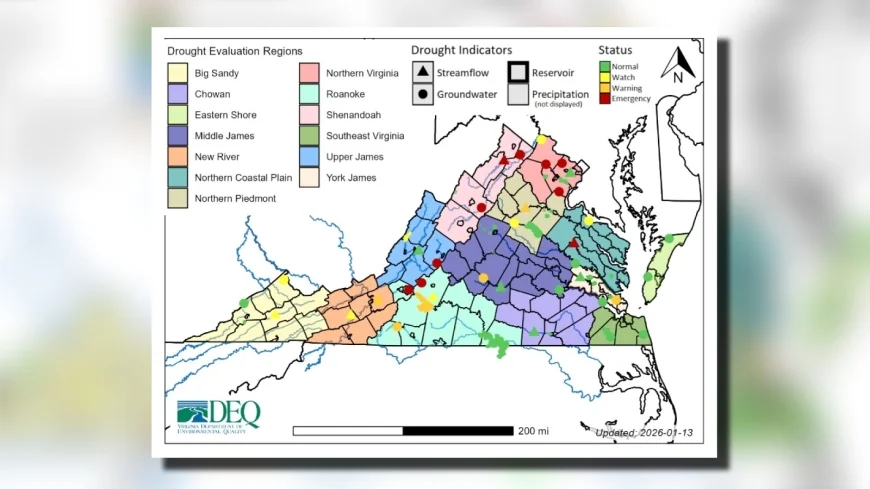
RICHMOND, Va. (WRIC) -- Groundwater and stream levels have dropped significantly below normal in some areas due to below-average rainfall over the past several months, leading to expanded drought warnings and watches across the Commonwealth.
Weedon Cloe, manager of the Department of Environmental Equality's (DEQ) Office of Water Supply, said that while reservoir levels remain stable, and there are no widespread water shortages, groundwater and stream levels are significantly below normal in some areas.
However, Cloe is urging Virginians to reduce water use by about 10% on a voluntary basis. This could mean shorter showers, washing cars or watering the gardens in the morning or evening.
"We're just looking for folks to cut back," Cloe told 8News. "And also inform localities and town cities and counties to perhaps start initiating their own drought conservation measures that each of these localities has in place."
Drought watch advisory expands
The update comes after the department, in coordination with the Virginia Drought Monitoring Task Force (DMTF), expanded its warning advisory on Monday, Feb. 9, to include 39 counties and 16 cities. The existing drought watch advisory has been maintained in 44 counties and 15 cities in Virginia.
MORE: What’s the difference between a drought advisory watch and a warning?
Cloe said the DMTF, comprised of state and federal agencies, comes together weekly amid a drought in the Commonwealth. They examine precipitation, surface water and levels such as stream, groundwater and reservoir.
"At this point, we don't have any leaves or plans for anything out using water, sucking it up from the natural world," Cloe said. "It really does all just come down to where did we get rain and how much did it rain, [along with] intensity and duration."
Some Central Virginia localities are split between the two advisories. For example, areas like Brunswick, Nottoway and Prince George counties remain under a warning advisory, while the cities of Colonial Heights, Hopewell and Richmond, along with the counties of Chesterfield, Hanover and Henrico, were added to the existing watch advisory.
With these ongoing drought advisories, some Virginians may question why parts of the Commonwealth still experience heavy rainfall or frequent flooding. Petersburg was hit particularly hard in July 2025 -- even resulting in a state of emergency.
State of emergency declared in Petersburg due to severe flooding
Urban areas such as Richmond and Petersburg have large amounts of impervious surfaces, including asphalt and concrete, which prevent water from soaking into the ground, Cloe said.
"It's a matter of stormwater runoff, and that can flow out and cause localized flooding when you have these really intense [rain] events," he said. "We're going to need a fair amount of precipitation to break the drought cycle that we've seen here in the Commonwealth over the last several months."
What are drought watch and warning advisories?
According to the DEQ, a drought watch aims to help Virginians prepare for the chance of worsening drought conditions.
In the latest update, the department wrote that “continued precipitation deficits” have led to “much-below normal streamflow, groundwater, and soil moisture levels” throughout most of the Commonwealth.
Cloe said that some areas in the state are experiencing a massive 25% precipitation deficiency, with streamflow and groundwater levels below 20% of normal. In areas under a watch advisory, deficits are closer or below 10%.
Meanwhile, the existing drought watch advisory aims to let Virginians be aware that the “onset of a significant drought event is imminent.”
Conditions expected to improve, but DEQ remains hopeful of replenishing
While Cloe said he and the department remain hopeful that conditions do not worsen significantly, the last major statewide drought emergency in Virginia happened in 2002 when former Gov. Mark Warner (D) declared a state of emergency in August of that year.
According to Cloe, the prolonged drought caused some areas to nearly run out of water and could mean Virginians limiting excess water use, turning off decorative fountains, restricting pool filling and implementing local emergency drought plans, which would be in coordination with local governments and utilities.
While the recent snowfall and rain have improved those surface conditions, Cloe said more rain is in the forecast.
"If for some reason the taps turned off, we're going to be in trouble, but right now, I'm very hopeful that we will go into spring with an adequate supply of precipitation that will replenish everything and we'll move forward," Cloe said.
Due to the drought watch and advisory, coordination is happening as needed, but Cloe said DEQ is prepared to increase outreach to local governments and affected localities if conditions worsen.
Right now, coordination is happening as needed, but DEQ is prepared to increase outreach if conditions worsen. However, he emphasized that water is a "very precious resource."
"You always hear about that, and it is an absolute truth," Cloe said. "We always ask folks, you know, if you're in a watch or warning area, just be [really] aware."