Debate over ‘Free Palestine’ mural in Richmond’s Northside leads to proposal for new design
 VENN
VENN
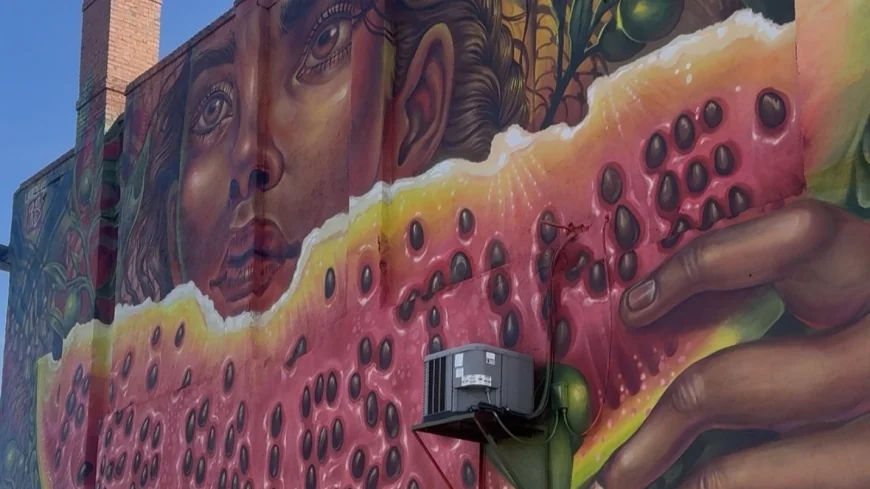
RICHMOND, Va. (WRIC) -- A mural on Richmond’s Northside is stirring up debate over its imagery and meaning.
It sits at the corner of Brookland Park Boulevard and North Avenue. The mural shows a darker-skinned woman holding a slice of watermelon, with the seeds spelling out "FREE PALESTINE."
Some Black community members said their issue is not the message, but the watermelon imagery -- which they say carries offensive stereotypes, especially in this historically Black neighborhood.

A controversial "Free Palestine" mural on a business in Richmond's Northside as of April 9. (Photo: Sara Molina/8News)
“A watermelon image in the Black community is offensive," said Gary Flowers, an artist and former member of the Public Art Commission. "We understand the history of the watermelon as a symbol of the Palestinian movement, and we support that."
Flowers said the issue comes down to context.
"This is not about Palestine," Flowers said. "This is about a Black community in Richmond, Virginia, that has been offended by an image placed here without community consent."
He is now calling for the mural to be replaced with an alternative design created by a local artist, Sir James L. Thornhill.

An alternative design concept for the controversial "Free Palestine" mural on a business in Richmond's Northside. (Photo: James Thornhill)
"This image connects the Black liberation flag of red, black and green, with the same colors that are included in the Palestinian flag," Flowers said. "We can make that historic connection, but at the same time, remove the offensive watermelon."
Teresa Sharpe, who owns the building, said there are no plans to change the mural. She said it was installed in December 2025 after she responded to a social media post from California-based artist "Lauren," seeking space for the work.
"Lauren put up this mural [to] protest the genocide that's occurring in Palestine," Sharpe said. "They tried to make that very clear by spelling out free Palestine in the watermelon, watermelon representing the Palestinian flag. When you start censoring things or changing things, you start to erase the symbolism that is currently existing there."
Lauren took to social media to explain this mural.
"The watermelon, a fruit grown in Gaza and the West Bank, symbolizes Palestinian identity," her statement reads, in part.
Sharpe will host a teach-in on Sunday, April 12, featuring both Black and Palestinian speakers.
"We wanted to also bring that together and teach everybody, have a discussion about it," Sharpe said. "About what's happening, but also how that relates to what has happened in the United States in the past, and how these two cultures have .., supported one another through different years of oppression."
Flowers said that such a discussion should have happened before the mural went up.
Lauren's statement will be posted on the mural wall as a plaque in the near future.