
Supreme Court could dramatically alter US election landscape
 VENN
VENN
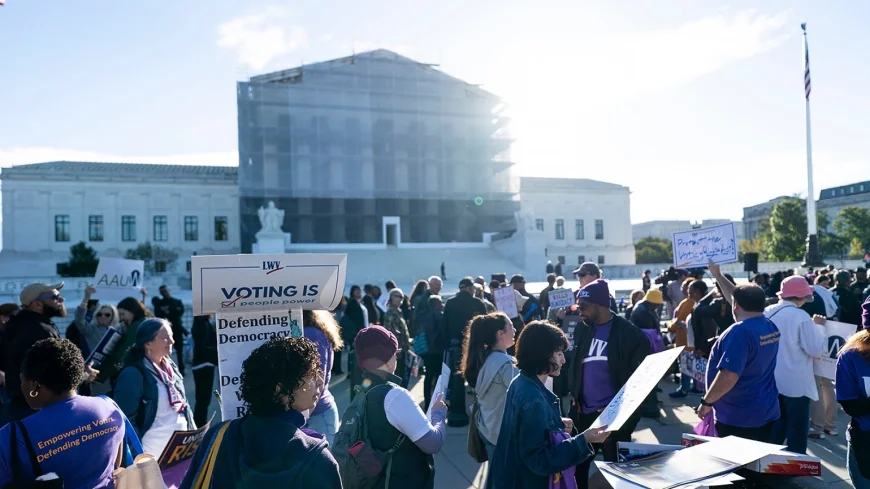
(The Hill) -- The Supreme Court could reshape U.S. elections for years to come as it hears a number of cases with implications for the country’s political landscape.
In perhaps the most high-stakes example, the country is waiting to see whether the justices decide to weaken a section of the Voting Rights Act.
Other rulings expected this year could alter how much political parties can spend in coordination with candidates or affect the deadline for casting ballots on time.
Here are some of the key cases to watch:
Louisiana v. Callais
Election experts and politicians alike are bracing for the Supreme Court to weigh in on Louisiana v. Callais, a case centered around the Bayou State’s congressional map that could decide the fate of the Voting Rights Act.
When the high court heard oral arguments in October, the conservative majority raised concerns that states like Louisiana were going too far in drawing majority-minority districts to comply with protections in the 1965 law, signaling they could move to limit the use of race in redistricting.
Voting rights activists, including the American Civil Liberties Union, have raised alarm that the court could open the floodgates for discriminatory maps.
“A lot is at stake with regard to Callais,” said Spencer Overton, a law professor at The George Washington University. “As a result of the Supreme Court's retreat from putting a check on partisan gerrymandering, Section 2 remains the last real break on unbridled gerrymandering.”
If the court curtails Section 2, which protects against racial discrimination in voting procedures, it could give Republican states in the South virtual free rein to redraw their congressional and legislative lines as a national redistricting fight rages on.
Republican-led redistricting in Texas this year kicked off a national scramble, prompting California to offset would-be Republican gains by passing its own redrawn map. Other states have since followed suit, with Florida this week becoming the latest GOP-led state to announce its intentions to redraw its map, citing the pending Louisiana case as a factor for officially launching the effort this April.
Still, whether states would be able to take action before this year’s midterms depends on the timing of the high court’s decision. Louisiana, for example, plans to use its existing congressional districts in 2026 because the Supreme Court did not rule before the end of last year, the Louisiana Illuminator reported.
There will likely be “an awful lot of political pressure” on some states to redistrict quickly if a decision comes soon enough, said Nicholas Stephanopoulos, an election law professor at Harvard Law School.
“If Texas redistricted before Callais, I would expect that Alabama, Louisiana, South Carolina, Mississippi would all redistrict after Callais, if there's any human way to get those new districts in place for 2026.”
Notably, the Supreme Court seemed poised to gut Section 2 in a 2023 case, but decided in a 5-4 ruling to keep it in place.
The Louisiana case was not included in the latest Friday release of Supreme Court opinions. Court watchers say that a ruling, especially if it’s one with major implications, is more likely in June, toward the end of the term.
NRSC v. FEC
In a case that will have major implications for how campaigns are funded, the Supreme Court is considering whether to strike down federal restrictions on coordinated spending between parties and their candidates in a challenge backed by Vice President Vance.
When Vance was a senator, he joined a fellow lawmaker and Republicans’ national campaign arms to sue the Federal Elections Commission (FEC), arguing that the longstanding caps on coordinated spending violate free speech.
Proponents of the restrictions say they prevent large donors from skirting contribution caps by funneling money to a candidate via a party, since federal law lets donors contribute more to a party than to an individual candidate. Others have contended that any changes to the limits should be left up to Congress.
The case was argued before the Supreme Court in December. Even if a decision comes closer to the summer, experts say a campaign finance decision could certainly impact the flow of funds as candidates rev up to November’s elections.
“Candidate committees and national party committees make plans about what to do with their money, but their plans can change, and so it's absolutely possible for a late-breaking decision to change the landscape,” said Justin Levitt, a constitutional law professor at Loyola Law School.
Stephanopoulos, however, cast doubt that the case could “dramatically transform” the system either way.
“Some of the money that right now might go to Super PACs will maybe instead flow to parties themselves. But since the super PACs are basically like shadow parties anyway, I think the effectiveness won't be huge,” he said.
Watson v. RNC
In Watson v. Republican National Committee (RNC), the Supreme Court has agreed to hear a case questioning whether states should be allowed to count mail-in ballots that come in after polls close.
In Mississippi, ballots have a five-day grace period to be counted, as long as they were postmarked by Election Day. More than a dozen other states and territories have similar windows, according to the National Conference of State Legislatures.
Republicans had convinced a lower court that the Mississippi statute goes against federal law, setting the first Tuesday in November as Election Day, and justices are being asked to overturn that ruling.
“Allowing states to count large numbers of mail-in ballots that are received after Election Day undermines trust and confidence in our elections,” RNC Chairman Joe Gruters said in a statement this fall.
The Democratic National Committee (DNC), on the other hand, filed an amicus brief on Friday arguing that if justices rule for the RNC, voters across the country would be disenfranchised by mail delays.
“Republicans’ continued assault on mail-in voting is an attack on our democracy and is wholly un-American,” DNC Chair Ken Martin said in a statement. “Voting by mail is safe, secure, and empowers voters who would otherwise struggle reaching a ballot box.”
Depending on the timing, there’s a chance a ruling could affect mail-in voting in the midterms, experts said.
Ohio Gov. Mike DeWine (R) last month reluctantly eliminated his state’s grace period for mail-in absentee ballots, citing the pending Mississippi case and concerns that Ohio elections would be “chaotic” if a ruling came down in the middle of the cycle.
Arguments in Watson v. RNC are expected in March or later, after the court granted a motion to give the parties more time for filings, with a decision to follow.
Bost v. Illinois State Board of Elections
A separate case related to mail-in voting, Bost v. Illinois State Board of Elections, could make it easier for candidates to bring lawsuits against state election laws.
Rep. Mike Bost (R-Ill.) and two of President Donald Trump’s electors are appealing a lower court ruling that found they couldn’t challenge Illinois’ law allowing ballots to be counted after Election Day.
Unlike in Mississippi, the matter at hand isn’t the ballot grace period, but rather whether Bost had the legal standing to sue.
If the Supreme Court reverses the lower court’s decision, candidates could have more leeway to challenge election laws and processes before Election Day.
The ACLU, the League of Women Voters and other voting rights groups notably filed in support of Bost’s standing, though they opposed his position on mail ballots.
The court heard arguments in this case in October, with a decision expected by June.