
GOP, Trump set for war powers confrontation with Democrats after Iran strikes
 VENN
VENN
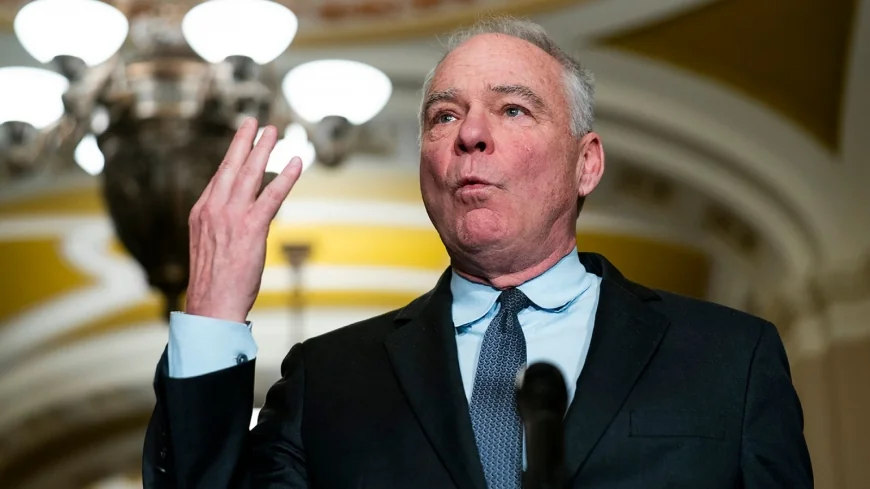
(The Hill) -- Lawmakers in both parties are bracing for a showdown in Congress this week over President Donald Trump’s authorities as commander-in-chief after weekend U.S. strikes on Iran that killed that country’s supreme leader and threaten to embroil the nation in war.
The Senate this week will debate and vote on a bipartisan war powers resolution sponsored by Sen. Tim Kaine (D-Va.) that would bring a halt to U.S. military action against Iran, though it has no chance of becoming law as Trump would be certain to veto it.
The debate in Congress this week will give Democrats a platform to argue that Trump’s order to strike Iran over the weekend was illegal and to demand the administration explain how it plans to end the conflict, which has resulted in Iran conducting retaliatory strikes against Israel and eight other Arab countries.
Kaine told reporters Sunday that he expects the resolution to come up for a vote on Tuesday and said he suspects GOP colleagues are concerned about a drawn-out conflict, something that could destabilize the broader region and drive up energy prices.
Signaling a new Democratic political argument, Kaine also criticized Trump for lacking a plan for Iran, while suggesting that even though the strikes killed Ayatollah Ali Khamenei, they may not result in actual regime change in Iran.
“The president seems to have no plan for the aftermath, and it looks like Iran is now poised to choose a new leader from the current regime,” he said during a press call.
Kaine says he won’t have enough votes to override a presidential veto, but argued, “I do think it’s really important to every member of Congress on the record about this.”
He also said the resolution can come back to the floor even if it fails.
It’s not entirely clear how the stunning news of Khamenei’s death will affect the vote.
Sen. Rand Paul (R-Ky.), a cosponsor of proposal to stop further hostilities against Iran without congressional approval, announced on Saturday “I must oppose another presidential war,” and at least two other Republicans, Sens. Susan Collins (R-Maine) and Lisa Murkowski (R-Alaska), are viewed as possible “yes” votes for the resolution.
Collins, in a statement, warned that “sustained combat operations require full engagement with Congress” while Murkowski said she expects Congress to be briefed in detail “so we fully understand the scope, objectives and risks of any further military action.”
A resolution sponsored by Kaine to restrict Trump’s use of force against Iran without approval from Congress failed to advance through the Senate in June in a vote that largely fell along party lines.
At the time, Paul was the only Republican to vote to discharge the measure from the Senate Foreign Relations Committee, and Sen. John Fetterman (Pa.) was the only Democrat to vote against it.
Fetterman, a staunch supporter of Israel, told reporters Thursday that he expects to vote against the resolution limiting Trump’s use of force against Iran when it comes back to the Senate floor.
“I supported the first strike on the Iranian facility,” he said, referring to Operation Midnight Hammer, the U.S. strikes on Iran’s nuclear facilities in June. “Everyone here agrees that we can’t ever allow Iran to acquire a nuclear bomb. And if you’re really serious about that, these are the kind of things that are necessary, and they all need to be on the table.”
Kaine on Sunday said the resolution may see more GOP support as the nation faces a prolonged military engagement.
“One of the reasons that people voted no last July was because they said, ‘It’s over. It’s one and done, it’s over,’” he said of the political environment after Operation Midnight Hammer.
“This is clearly going to be longer-term engagement, according to the president, so I’m hopeful that we’ll get more,” he said.
Several high-ranking Republicans have argued that regime change should be the ultimate goal of any effort with Iran.
“Regime change should be our goal. Their theme has been ‘Death to America’ for half of a century, and there’s no realistic hope of a genuine negotiation,” said Senate Armed Services Committee Chairman Roger Wicker (R-Miss.), referring to attempts by special envoys Jared Kushner and Steve Witkoff to negotiate a nuclear arms deal with Iran in recent weeks.
Senate Majority Leader John Thune (R-S.D.) and Sen. Ted Cruz (R-Texas) have also called for regime change.
Besides killing Khamenei, the weekend strikes also took out several other senior Iranian officials, including Ali Shamkhani, the head of the national defense council, Mohammad Pakpour, the leader of the Islamic Revolutionary Guard Corps, and Defense Minister Aziz Nasirzadeh.
But the country’s authoritarian regime remains in place. Iranian President Massoud Pezeshkian announced that an interim leadership council would begin to work on picking a new leader.
The Trump administration has ruled out deploying troops to topple the ruling class and usher in a government friendlier to the United States on Israel. Vice President JD Vance last week said there’s “no chance” the United States would get pulled into a prolonged war.
President Trump, however, has said the attacks will continue for some time. In an interview with the Daily Mail, Trump said the plan has always been for a “four-week process.”
“We figured it will be four weeks or so. It's always been about a four-week process so -- as strong as it is, it's a big country, it'll take four weeks -- or less,” he said in the interview.
Sen. Mark Warner (D-Va.), the vice chairman of the Senate Intelligence Committee, warned of a longer fight that could result in additional American fatalities. The Pentagon announced Sunday morning that three U.S. troops were killed in action and another five were seriously injured.
“For anyone to pretend or assume that this is over at this point, that Iran is not going to continue to strike back … the president himself said on Friday night when he launched this war that he expected casualties,” Warner said in an interview on CNN’s “State of the Union.”
Iran on Sunday unleashed a barrage of missiles at Israel, where it killed at least nine people in a city about 20 miles west of Jerusalem, and several other Arab countries, including the United Arab Emirates, Qatar and Bahrain.
Senate Intelligence Committee Chairman Tom Cotton (R-Ark.) said Sunday that U.S. military operations over the next several days will focus on destroying Iran’s conventional missile program.
“What the American people will see in the days ahead will be a methodical and systematic focus on Iran’s missiles, its missile launchers and ultimately its missile manufacturing capability so they can’t continue to threaten our troops, Israel and our other friends in the region,” Cotton said on CNN’s “State of the Union.”
Cotton said the destruction of Iran’s military apparatus should encourage Iranians who staged mass protests against the government earlier this year to return to the streets.
“I would suspect we’ll see more and more Iranians taking to the streets to try to take back their own destiny,” Cotton said.
“As we focus on Iran’s missiles and their missile launchers and their missile manufacturing capability and on their pillars of power, we are hopefully going to degrade the regime’s ability to oppress its own people,” he added.
The debate on the war powers resolution will force Republicans to defend the president’s decision to target Iran while giving Congress little advanced notice.
Secretary of State Marco Rubio notified members of the “Gang of Eight,” which includes party leaders in both chambers and the top Republicans and Democrats on the Senate and House Intelligence committees shortly before the strikes began — but lawmakers were otherwise kept in the dark about the operation.
Warner said he had not reviewed any intelligence indicating that Iran planned to strike U.S. troops or allies before Trump launched the attack, framing the U.S. military operation as a war of choice — not necessity.
“I saw no intelligence that Iran was on the verge of launching any kind of preemptive strike against the United States of America,” he said.